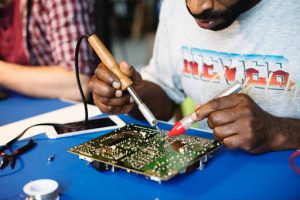


This was an ICT innovation fellowship program in Uganda implemented by RAN in partnership with the Research and Education Network for Uganda (RENU) between 2021 and 2023 with funding from The Marconi Society. The Celestini Program, named after Guglielmo Marconi’s yacht where early radio experiments were conducted, aimed to nurture the next generation of connectivity innovators in Africa. The program supported emerging ICT innovators in developing solutions to connectivity challenges in underserved communities.
The Uganda fellowship program focused on addressing the “last mile” connectivity challenges that persisted despite national fiber backbone infrastructure development, particularly in rural, remote or underserved areas. The program selected five promising innovators or teams through a competitive process, providing them with financial support, technical mentorship, and access to RENU’s network infrastructure for testing and validation. Projects spanned various aspects of connectivity innovation including:
- Low-cost wireless mesh networks for community connectivity,
- Solar-powered connectivity solutions for off-grid areas,
- Innovative spectrum utilization approaches to maximize existing infrastructure,
- Applications leveraging intermittent connectivity for essential services, and
- Local content development to increase the value of connectivity.
The program emphasized development of solutions that were both technically sophisticated but also practical and sustainable in resource-constrained environments. Fellows received mentorship from faculty experts at Makerere University, RAN and RENU. Technical support included access to software-defined radio equipment, spectrum analyzers, and network testing tools through RAN’s and RENU’s facilities and networks. The program also included capacity building in innovation entrepreneurship, helping fellows develop business models for their connectivity solutions, understand regulatory requirements for telecommunications innovations, and plan pathways to scale. The innovators also validated their solutions under diverse conditions and iterated based on actual user feedback.